
March 10, 2026
Visual Failure of Titanium Weld to D17.1
What Does a Failed Titanium Weld Test Look Like? Lessons from AWS D17.1 Class A
Titanium welding is often described as unforgiving, and for good reason. Even small deviations in technique or shielding can lead to defects that immediately disqualify a weld from meeting strict aerospace standards. One of the most common—and most visually obvious—failures appears as colorful discoloration across the weld surface.
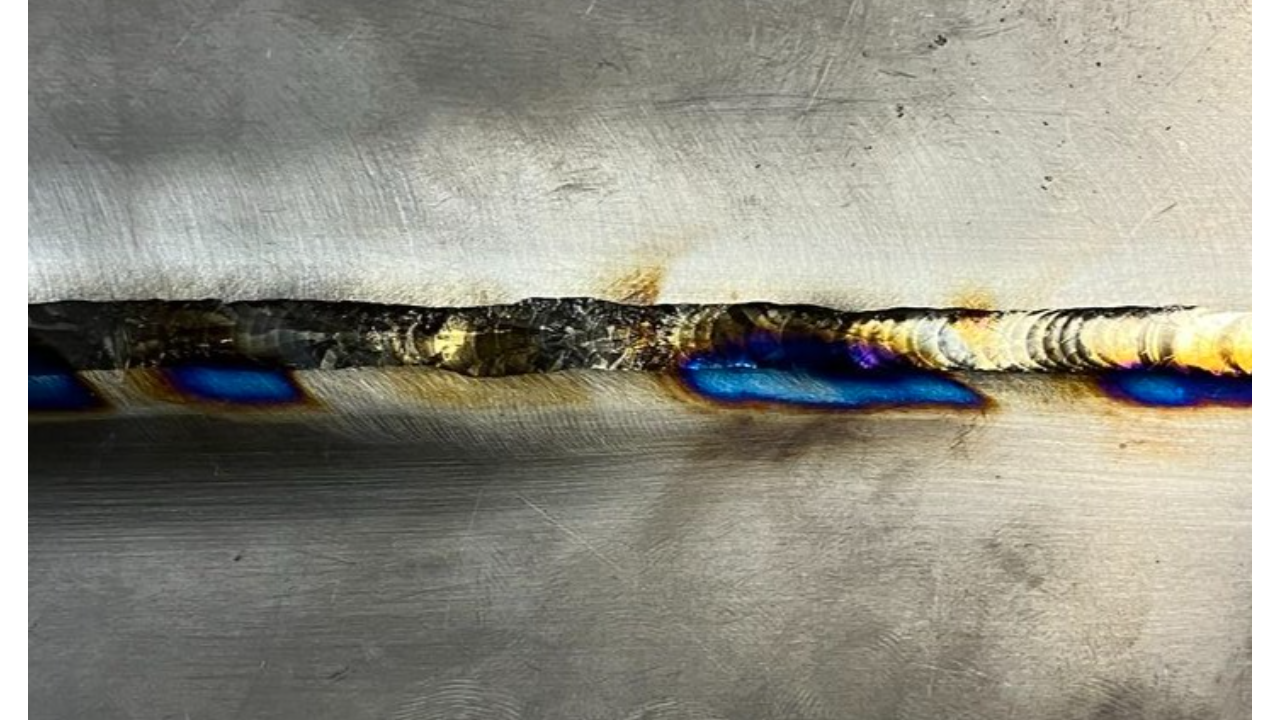
At first glance, the weld may look almost beautiful, with purple and blue tones shimmering across the bead. In reality, those colors are a clear sign that the weld has already failed inspection.
When Color Means Failure
In a recent weld test, a titanium weld coupon was evaluated under AWS D17.1 Class A, the standard typically applied to flight-critical aerospace hardware. The weld was rejected immediately during visual inspection due to the presence of purple and blue discoloration on the weld surface.
While visually striking, these colors signal a serious metallurgical issue.
Discoloration in titanium welds indicates that the molten weld pool was exposed to atmospheric impurities such as oxygen or nitrogen during the welding process. Titanium has an extremely high affinity for these elements at elevated temperatures. When contamination occurs, it leads to embrittlement—a condition where the material’s tensile strength increases while its ductility decreases.
In other words, the weld becomes stronger but significantly more brittle, increasing the risk of catastrophic failure under stress.
Titanium is far more susceptible to this phenomenon than most structural metals, which is why shielding and process control are so critical.
The Strict Reality of AWS D17.1 Class A
AWS D17.1 Class A is among the most demanding welding standards. It is specifically intended for flight-critical components, where failure could have severe consequences.
Because of this, the acceptance criteria are extremely strict. Even minor visual imperfections can result in immediate rejection.
Interestingly, welds like the one described above might still pass destructive mechanical testing or radiographic (X-ray) inspection. Structurally, they may appear sound. However, when dealing with flight-critical hardware, visual indicators of contamination alone are enough to disqualify the weld.
In aerospace manufacturing, the standard is not simply “good enough”—it is zero tolerance for uncertainty.
Discipline Over Talent
Meeting D17.1 Class A requirements does not require superhuman welding ability. More often, success comes down to discipline, repeatable processes, and strong process control.
Titanium welding demands careful management of every variable that could compromise shielding. When troubleshooting discoloration issues, several factors must be evaluated and controlled, including:
Torch consumables
Shielding gas flow rate and purity
Tungsten stick-out
Torch angle and travel speed
Cleanliness of the weld joint
Weld output parameters
Any weakness in shielding coverage—especially on the trailing weld area or the backside of the joint—can introduce contamination.
Small Adjustments, Big Results
In this case, the solution was surprisingly simple.
After evaluating the process, it became clear that the welder only needed to make minor adjustments to travel speed and torch angle. Once those variables were corrected, the welder produced a new sample that successfully passed both destructive and non-destructive testing under AWS D17.1 Class A criteria.
What initially appeared to be a complex welding problem turned out to be a matter of fine-tuning technique within a controlled process.
The Role of a Strong Quality Management System
Producing consistent, code-compliant welds—especially under rigorous aerospace standards—rarely happens by accident.
Organizations that succeed in environments like aerospace manufacturing typically rely on a comprehensive Quality Management System (QMS). A well-structured QMS transforms what might seem like an overwhelming technical challenge into a clear sequence of measurable, repeatable steps.
Instead of relying on guesswork or individual heroics, the process becomes systematic:
Identify the variables.
Measure them.
Control them.
Adjust when necessary.
When done correctly, even the demanding requirements of AWS D17.1 Class A become manageable.
And sometimes, the difference between a failed titanium weld and a flight-ready one is nothing more than a slight adjustment to torch angle and travel speed.