
February 25, 2026
Operating the Orbital Welding System
From Prototype to Production: Building an Orbital Welding System for Inconel 617
We recently put our shop-made orbital welding machine to work laying beads on Inconel 617 — a nickel-based superalloy known for its strength at extreme temperatures and its reputation for being… less than forgiving.
To the surprise of absolutely no one, the project turned out to be more complex than anticipated.
But complexity is often the price of precision, and you can’t argue with the quality of the result.
What started as a concept evolved into a tightly integrated system of mechanical control, electronics, and advanced welding parameters. More importantly, it became a case study in what it really takes to move from prototype hardware to production-ready automation.
The System Architecture
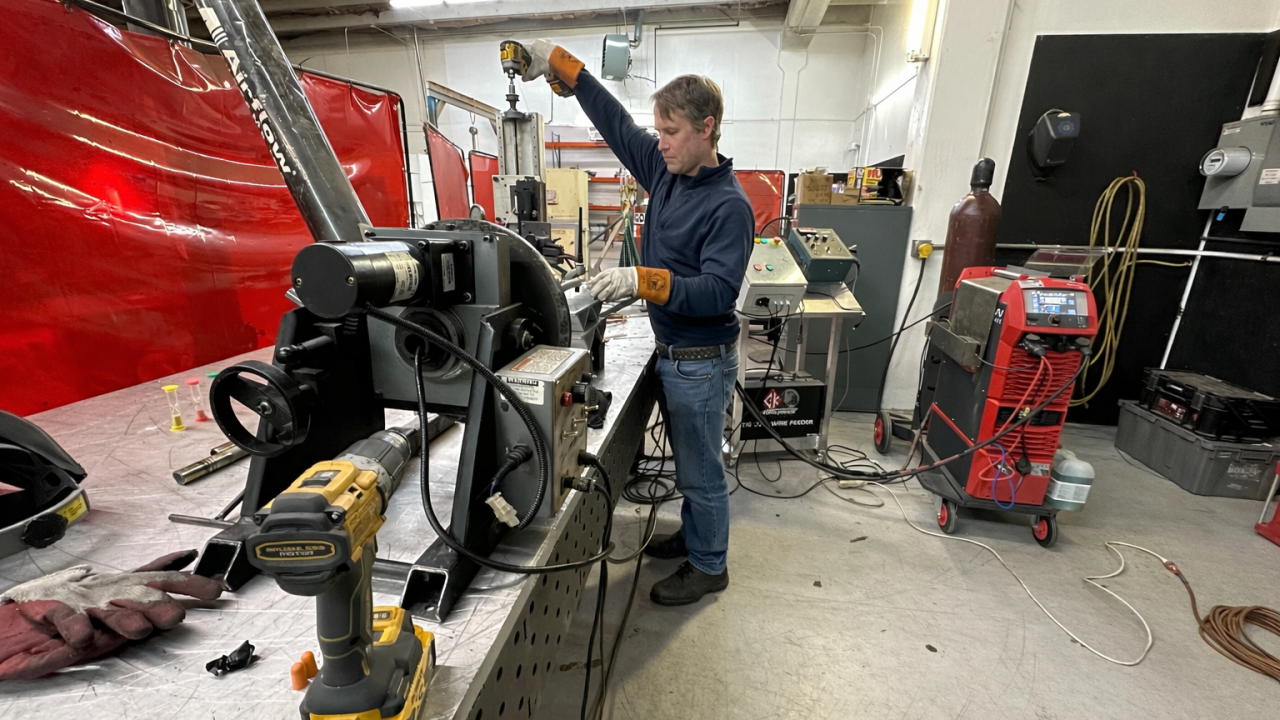
At its core, this orbital welding setup combines mechanical rotation, fine torch control, real-time arc management, and custom electronics.
From left to right, the key components include:
Variable Speed Rotator
Provides controlled part rotation, forming the foundation of consistent orbital weld geometry.
Torch Holder Assembly
Designed with two levels of adjustment:
Manual rough adjustment for setup and alignment
Servo-controlled fine adjustment for precise torch positioning during operation
The “Brain”
Housed inside a white NEMA enclosure, the control system includes
Arduino microcontroller
Digital potentiometer (controlling the rotator)
Servo with 1k analog potentiometer (controlling the welder)
Switching system for the TIG wire feeder
All of this is orchestrated by 408 lines of Arduino code — not pictured, but doing plenty of heavy lifting.
Arc Voltage Controller
Maintains consistent torch height during welding. This is critical for:
Out-of-round parts
Dimensional inconsistencies
Maintaining arc stability and repeatable penetration
Fronius IWave 300
The power source central to the system’s performance.
The Real Challenge: Electromagnetic Interference
The mechanical build was straightforward compared to what came next.
High-frequency TIG starts introduced electromagnetic interference (EMI) that initially caused Arduino CPU resets. In practice, this meant random runaway welds, thankfully only on scrap parts.
Solving this required layered mitigation strategies:
High-frequency arc grounding to prevent EMI-induced resets
Coded hard stops based on calculated runtime
CPU reboot safeguards to prevent uncontrolled operation
Improved physical grounding across the system
Cleaned up cable routing to reduce noise and interference pathways
The lesson here is: once you integrate microcontrollers into high-frequency welding environments, electrical discipline becomes just as important as weld technique.
Dialing in the Weld: Heat Input and Arc Control
Inconel 617 demands tight heat control. Too much heat risks distortion and metallurgical compromise. Too little heat sacrifices fusion.
Two elements proved especially critical:
Ultra-High Frequency Pulse Settings
The Fronius ultra-high frequency pulse allowed us to maintain a stiff, focused arc at relatively low heat input. This made it possible to achieve:
Stable puddle control
Reduced overall thermal input
Improved bead consistency
Data-Driven Parameter Transfer
One major advantage of the Fronius system was built-in data collection.
We began by dialing in parameters manually. Once optimized, those settings were transferred directly into the automated system — dramatically reducing development time.
Manual welding informed automation. Automation amplified repeatability.
What This Means for Scaling
There’s a major gap between proving something works once and proving it works every time.
Bridging that gap requires more than good welding — it requires systems thinking:
Mechanical precision
Electrical robustness
Software safeguards
Process validation
Data-driven refinement
When advanced welding techniques are paired with a problem-solving mentality, it’s possible to create order-of-magnitude improvements in consistency, throughput, and scalability.
That’s the real value of projects like this.
They’re not just about making a clean weld on Inconel. They’re about building the infrastructure that makes scaling possible.
If you're working on transitioning high-performance prototypes into repeatable production processes, we’d love to connect.