
January 14, 2026
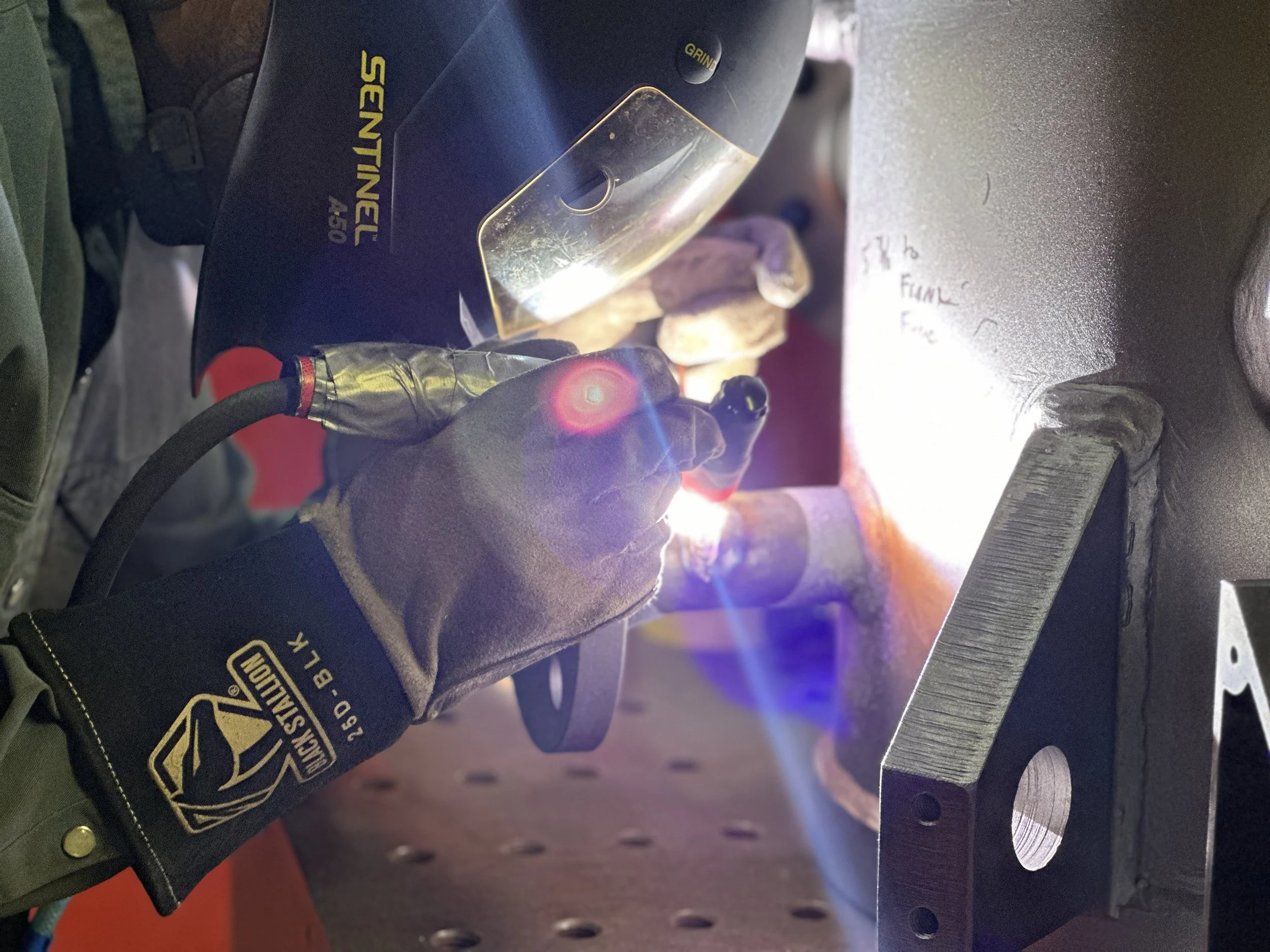
Welding on a ASME Pipe Spool System
Are “Certified” Welding Shops Misleading You? Here’s the Reality.
Not exactly, but the truth is more nuanced than most people realize.
A welding certification often means that a welder successfully passed a specific test at a single point in time. That test is conducted under controlled conditions and applies only to a narrow range of variables. Despite this, many shops present “certified” status as if it guarantees broad capability across all projects and conditions.
There’s a significant difference between holding a certification and operating as a true code-compliant welding shop.
Shops that consistently deliver high-quality, compliant work go far beyond a one-time test. They maintain:
A deep understanding of both technical and administrative code requirements
In-house non-destructive testing (NDT) capabilities
Ongoing welder training and qualification programs
Full material and filler metal traceability
Documented procedures and strict process control
Subcontractor qualification, audits, and agreements
In short, they have repeatable systems that ensure weld quality, compliance, and documentation—every single time.
Recently, we were called in to rebuild a piping system after a previous contractor’s welds failed inspection. The bigger issue? They couldn’t provide documentation for:
The welds themselves
The welding procedures used
Welder qualifications
We performed the rebuild on-site, with all welds inspected to ASME B31.3 standards. This included:
Visual inspection
Magnetic particle testing (by a certified third-party inspection company)
To stay ahead of potential delays, we also conducted in-house borescope and dye penetrant testing before third-party inspection.
The takeaway is simple:
Certification alone doesn’t guarantee quality or compliance. What matters is whether a shop has the systems, discipline, and documentation to consistently deliver code-compliant work.
If your project depends on weld integrity, make sure you're evaluating more than just a certification—look at the process behind it.